
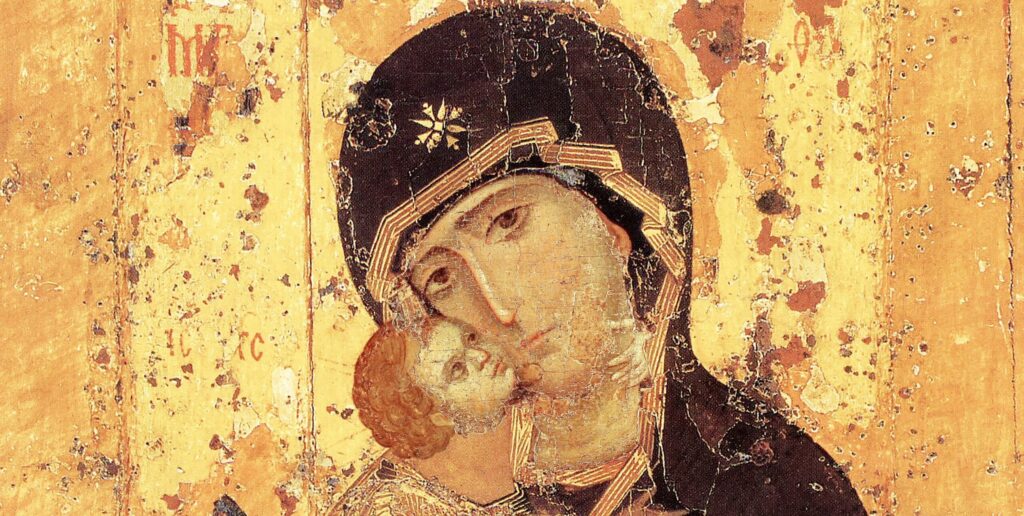
The Virgin of Vladimir is one of the most revered icons in Russia, recognized for its miraculous powers that have historically protected Moscow from destruction during invasions, fires, and wars. Created in the 12th century in Constantinople, this Byzantine masterpiece holds deep significance for Russian identity, symbolizing divine protection. Its small size (78×55 cm) raises questions about its immense impact and the reasons behind the retreat of invaders in its presence.
Also known as the Mother of God of Vladimir, this icon has not only survived the passage of time but has also experienced numerous miracles, restorations, and political implications throughout history. It was likely painted by an unknown Byzantine artist for the imperial court, depicting a poignant moment between the Virgin Mary and Jesus Christ in a style known as Eleusa, which means “tenderness.” In this artwork, the child nestles close to his mother, reflecting both divine love and human vulnerability, while Mary’s somber expression hints at the premonition of Christ’s future sacrifice.
In 1131, the icon was gifted to Grand Prince Yuri Dolgoruky of Kiev, the founder of Moscow. It was later brought to Vladimir in 1155 by his son, Prince Andrew Bogolyubsky. Legends tell that the horses carrying the icon refused to move beyond Vladimir, interpreted as a divine sign that the Virgin wished to stay there. Prince Andrew subsequently built the Assumption Cathedral to house the icon, which quickly became a symbol of divine protection for the city and elevated the status of Vladimir as a spiritual and political center in medieval Russia.
The Virgin of Vladimir is credited with numerous miracles closely linked to Russian history. For example, in 1395, during the invasion by Timur (Tamerlane), as his forces approached Moscow, the icon was paraded through the city, leading to an inexplicable retreat of Timur’s army and sparing Moscow from destruction. Similarly, in 1480, during the Great Stand on the Ugra River, the icon was taken to the battlefield, where its presence is believed to have emboldened Russian troops against the enemy.
These supposed miracles have been chronicled in historical texts and continue to inspire devotion among the faithful. Historian Sergey Ivanov notes that the Virgin of Vladimir has become a symbol of divine favor for the Russian people, serving as a tangible link between heaven and earth.
The survival of the icon itself is often seen as a miracle. During the 13th century, amid the Mongol invasions, the Assumption Cathedral in Vladimir was set ablaze, and while the fire damaged the back of the icon, the image of the Virgin with Child remained unscathed. Over the years, the icon has undergone at least five major restorations to preserve its fragile condition. Each restoration has sought to balance maintaining the original artwork with repairing damage caused by time, war, and reverence, with the most recent restoration occurring in the 20th century using advanced stabilization techniques.
In 1657, the icon was adorned with an elaborate riza (decorative metal frame), which further transformed its appearance. This included gold embellishments for the garments of the Virgin and Child, as well as intricate jewelry and pearls that decorated the figures’ halos. The riza also added a crown to the Virgin, emphasizing her title as the “Queen of Heaven.”
Today, the icon resides in the Tretyakov Gallery in Moscow under controlled conditions ensuring its preservation. The painting now measures 106 x 69 cm, including framing, while the original image retains its dimensions of 78 x 55 cm, indicating it was intended for display within a church, near the altar, and meant for religious processions.
The story of the Virgin of Vladimir not only illuminates the intersection of faith and art but also reflects the profound cultural and historical legacy it embodies for the Russian people, acting as a powerful symbol of protection, resilience, and continuity through centuries of turmoil.


