
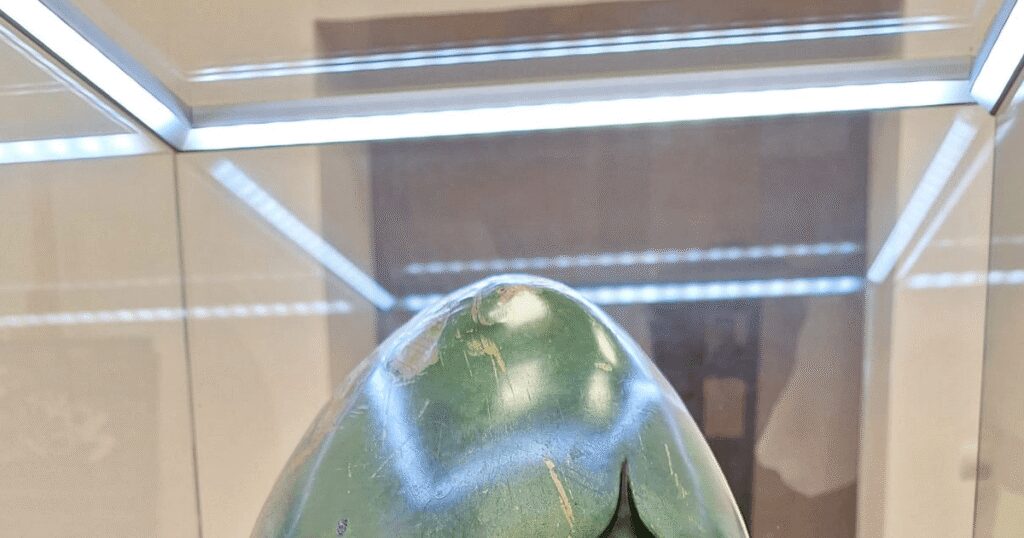
The Chalcidian Helmet from Balș, a bronze artifact dating back approximately 2,500 years, was first displayed in Slatina last week, marking the 73rd anniversary of the establishment of the Olt County Museum. This helmet was discovered by chance in 2005 in Balș, Olt County, and belongs to type II of the Thracian group (Pflug). Its production area primarily includes Greece, Italy, Macedonia, and Thrace, as noted by the museum on its Facebook page.
Historical Significance
The Olt County Museum highlights the helmet’s significant archaeological value, indicating it was crafted in a Greco-Macedonian workshop in the northern Aegean or by itinerant Greek artisans south of the Danube. This military helmet likely belonged to an aristocrat or notable warrior from the 4th century BCE.
Description and Features
The helmet exhibits a "phallic" morphology with an ellipsoidal cap. It features a distinct line separating the upper part from the lower neck guard, which curves around the neck. The elongated, vertical cheek guards include ear openings and are framed with wide arches, while the short nasal guard has a straight finish. The front edge of the cheek guards is serrated, while the back and lower edges are rounded. Each cheek guard is adorned with decorations resembling stylized ram horns, made using the “au repoussé” technique.
Key dimensions of the helmet include:
- Height: 26.8 cm
- Maximum cap circumference: 65 cm
- Thickness: 1.8 mm around the eye area and 2.8 mm at the neck
- Weight: 820 grams
Analytical Insights
The helmet underwent metalographic analysis in 2005 at the Horia Hulubei Institute of Physics and Nuclear Engineering in Bucharest. Using X-ray fluorescence (XRF) with a Americium-241 radioactive source, the analysis confirmed that the helmet is made of a copper-tin alloy, comprising 65% copper and 35% tin. Traces of nickel, zinc, arsenic, and minor amounts of lead, iron, silver, and gold were also detected, suggesting that the artifact may have originally featured silver or gold details.
Regional Context and Comparisons
Similar helmets found in the North Danube area, including those from Budești in Călărași County and Cuptoare in Caraș-Severin County, share both morphological and geographical features with the Balș helmet. Additionally, Chalcidian helmets have been identified in Făcău (Giurgiu County), Zimnicea (Teleorman County), Mercina (Caraș-Severin), Olănești (Ștefan Vodă region, Moldova), and cheek plates from Ocna Sibiului (Sibiu County). These comparisons outline the distribution of this type of defensive equipment north of the Danube.
Dual Functionality of Armor
The bronze helmets serve dual purposes: they are practical protective gear in battle and symbols of prestige. Their contemporaneity with the more famous princely helmets made of gold and silver—drawn from Chalcidian designs—illustrates a hierarchical organization within the Thracian society of the northern Balkan Peninsula, particularly among the Getae.
Cultural Implications
The discovery of the helmet contributes valuable insights into the identity and cultural context of elite Getae individuals from the 5th to 3rd centuries BCE. This context reflects a significant connection to the Greco-Macedonian civilization during that period.


