
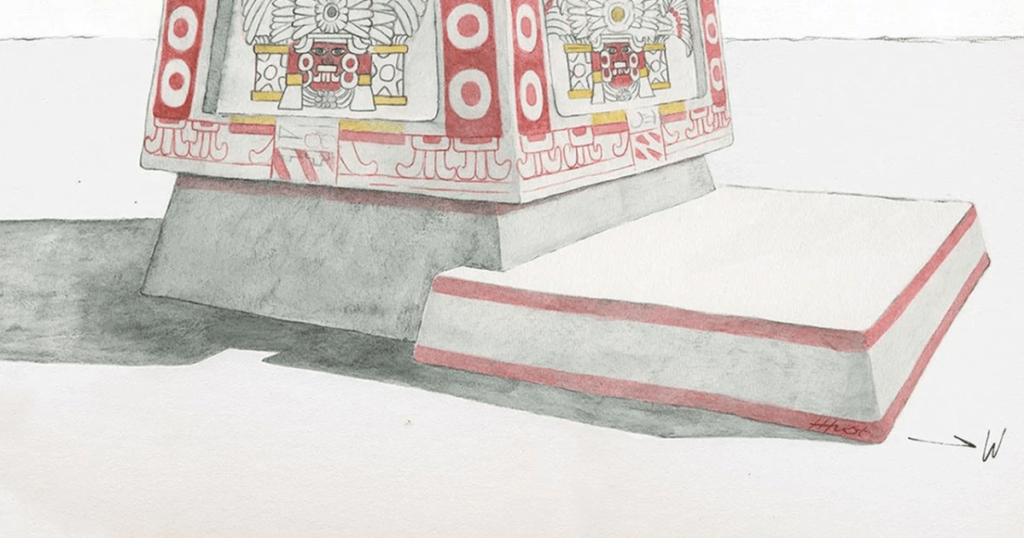
Recent archaeological discoveries in Tikal National Park, Guatemala, have revealed a lavish painted altar that provides insights into the historical relationship between the ancient Maya city of Tikal and the central Mexican metropolis of Teotihuacan. This altar was found in a private complex near the center of Tikal and is considered a rare and significant artifact, indicative of intense cultural exchange and dramatic political changes that occurred more than 1,600 years ago.
Dating back to the late 4th century CE, the altar features elaborately painted panels in shades of yellow, black, and red, portraying a figure with almond-shaped eyes, a feather crown, a nasal bar, and two ear discs. These images closely resemble central Mexican representations of the "Storm God," a deity worshipped in Teotihuacan, located approximately 1,000 kilometers north-west of Tikal.
A study published on April 8 in Antiquity, involving researchers from Brown University and Guatemalan institutions, indicates that the altar was likely not constructed by the Maya, but rather by an artisan trained in the Teotihuacan style. Stephen Houston, a professor of anthropology and history of art at Brown, noted that this period was marked by extraordinary turbulence for Tikal. The altar underscores the arrival of wealthy leaders from Teotihuacan who replicated the ritual structures of their home city in Tikal.
Edwin Román, director of the excavations and head of the Southern Tikal Archaeological Project, explained that the find illustrates the sociopolitical and cultural interactions between the two civilizations during the period of 300-500 CE. Román emphasized that this discovery affirms Tikal’s status as a cosmopolitan center, hosting guests and influences from distant regions.
The altar, approximately two meters by one meter and made of limestone, exhibited features typical of Teotihuacan’s ritual practices. Human remains were uncovered nearby, including an unusually positioned burial of a child, common in Teotihuacan but not among the Maya. Additionally, a green obsidian spear point found adjacent to an adult reinforced the idea of a foreign presence.
Andrew Scherer, a professor of archaeology at Brown and co-director of the project, noted that the altar was deliberately buried, with the surrounding area remaining unused. He explained that while the Maya often buried structures and built over them, in this case, the altar and its surrounding buildings were left undisturbed, treated almost like a memorial or a contaminated area, reflecting complex feelings towards Teotihuacan.
The altar’s discovery also supports an older theory suggesting a coup d’état that altered the leadership of Tikal around 378 CE. Decades of research suggest that forces from Teotihuacan dethroned a local king and installed a puppet ruler aligned with their interests. Houston elaborated that they replaced the king with a collaborator who became a useful local instrument for Teotihuacan.
Further evidence supporting this theory comes from previous LiDAR (Light Detection and Ranging) studies conducted by the Brown University team, revealing a scaled-down replica of Teotihuacan’s central citadel buried near Tikal’s city center. This structure had previously been misidentified as natural hills, suggesting a possible long-term occupation or surveillance presence.
Despite the disruptive nature of Teotihuacan’s intervention, Houston pointed out that this event may have paradoxically contributed to Tikal’s long-term regional power growth. He remarked on the nostalgia surrounding that period, noting that even during its decline, the locals continued to define their politics in relation to the contact moment with central Mexico.
This remarkable find not only provides new insights into the interactions between Tikal and Teotihuacan but also helps to contextualize Tikal’s role in the broader dynamics of Mesoamerican history, highlighting how external influences shaped local developments and identities.
Source:
Román Ramírez E, Paiz Aragón L, Bass A, et al. (2025). A Teotihuacan altar at Tikal, Guatemala: central Mexican ritual and elite interaction in the Maya Lowlands. Antiquity; 99(404):462-480. doi:10.15184/aqy.2025.3.


