
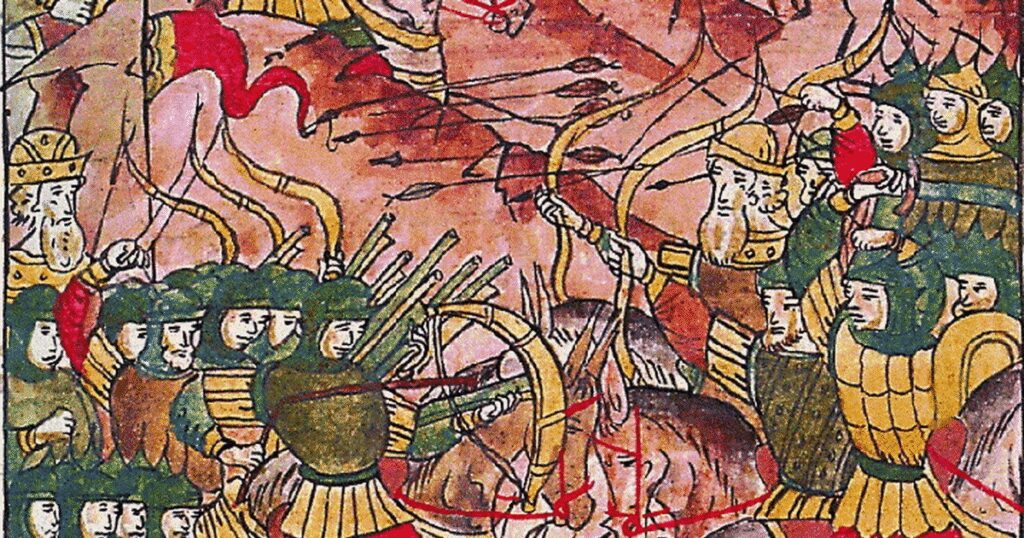
The story of Voivode Ștefan I of Moldavia from the Mușatin family is a fascinating yet lesser-known chapter in history. It begins with his rise to power, aided by King Vladislav Jagello of Poland, and is characterized by his fierce leadership and military prowess.
Upon taking command in Moldavia, Ștefan faced an immediate challenge from Sigismund of Luxembourg, the King of Hungary, who launched a significant military campaign against him in early 1395. The Hungarian forces, entering Moldavia through the Oituz and Bicaz passes, encountered fierce resistance from Ștefan’s troops. The Moldavians utilized guerrilla tactics, ambushing the Hungarian knights as they traversed snowy hills, forcing them to dismount and fight in difficult conditions.
Despite initial successes, Sigismund’s campaign culminated in a retreat after facing a decisive defeat at Ghindăoani, where Ștefan launched a counterattack. This battle set a precedent for future interactions; Sigismund would later experience similar defeat during his attempts to assert control over Moldavia, mirrored ironically by Matthew Corvin’s defeat at Baia decades later.
Unfortunately, the narrative of Ștefan I does not end on such a triumphant note. Several years after his confrontation with Sigismund, it is believed he met his end under uncertain circumstances, potentially during the disastrous Battle of the Vorskla River, where Lithuanian forces were defeated by the Mongol-Tatar armies led by Timur Lenk.
The detailed account of Ștefan I’s life is explored in the “Colecționarul de istorie” podcast by Andrei Pogăciaș, who dives into the complex regional power dynamics of the time. He discusses the alliances and conflicts that shaped Moldavia’s position, including Ștefan’s engagements beyond the Dniester with the Mongol-Tatars and the Polish campaigns against the Teutonic Knights. Sigismund’s ambition to bring Moldavia under his control showcases the political maneuvering that characterized the period.
In essence, Ștefan I’s story illuminates the turbulent epoch of medieval Eastern Europe, where conflicts were driven by both personal and territorial ambitions. His legacy, primarily defined through his military engagements and strategic alliances, ultimately reflects the broader historical narratives of resistance and survival in face of external pressures.


