
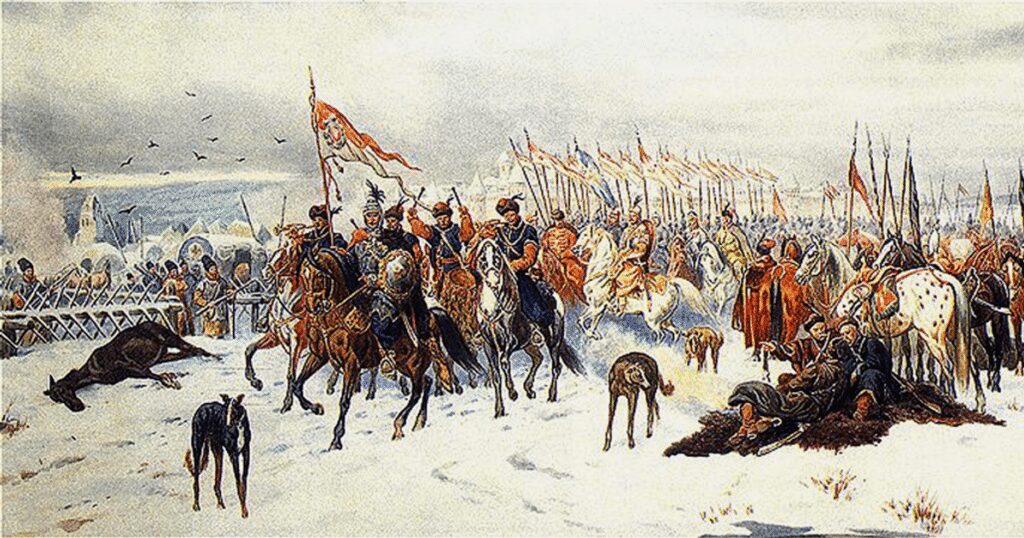
Summary of the Polish-Russian War (1609-1618)
The Polish-Russian War from 1609 to 1618 marked a significant conflict in early 17th-century Eastern Europe, initiated by the Polish-Lithuanian Commonwealth with ambitions to expand into Russian territories. This move capitalized on the weakened state of the Tsardom of Russia, which was embroiled in internal strife, including civil wars and dynastic crises.
Background and Alliance Formation
Prior to the war, Polish incursions into Russian lands were not uncommon, but tensions heightened with the establishment of an anti-Polish alliance between Russia and Sweden in 1609. In reaction, Polish King Sigismund III Vasa officially declared war on Moscow. Early on, Polish forces achieved considerable victories, including a major triumph at the Battle of Klushino in 1610 against Russo-Swedish troops, leading to Moscow’s occupation and the proposed election of Vladislav IV Vasa (Sigismund’s son) as the new Tsar.
Internal Divisions and Occupation
The Russian nobility, or boyars, were split regarding Vladislav’s claim to the throne; pro-Polish factions supported his ascension provided he converted to Orthodox Christianity. However, Sigismund’s ambitions shifted towards directly imposing Polish culture and Catholicism in Moscow. This created further discord, culminating in a Moscow uprising in 1611 led by Alexandru Gosiewski, which the Poles suppressed.
In September 1613, the Russians successfully recaptured Moscow through the efforts of Prince Dmitry Pozharsky and merchant Kuzma Minin, leading to the ousting of pro-Polish officials and the election of 16-year-old Mikhail Romanov as the new Tsar. Meanwhile, the Polish-Lithuanian Commonwealth faced mounting economic difficulties as unpaid soldiers stationed in Russia revolted, and attempts to recapture the city of Smolensk failed.
Further Campaigns and Ceasefire
In 1615, Polish noble Aleksander Józef Lisowski and his mercenaries raided around Moscow, capturing additional territories in subsequent years. Despite Mikhail Romanov’s coronation, Vladislav IV persisted in claiming the Russian throne, launching a campaign in 1617. By autumn of 1618, Polish forces besieged Moscow again but suffered another defeat, leading to the Treaty of Deulino, signed in late 1618.
Although Sigismund failed to claim the Russian throne, Poland successfully expanded its territory, acquiring the cities of Smolensk, Novhorod-Siverskyi, and the Chernihiv Voivodeship. Nevertheless, the economic burden of the war strained the Polish-Lithuanian Commonwealth severely.
Conclusion of the Conflict
The Treaty of Deulino held until 1632, when Russians attempted to reclaim Smolensk following Sigismund III’s death. Ultimately, the Treaty of Polyanovka in May 1634 required Russia to pay 20,000 rubles in compensation while Vladislav IV relinquished any claims to the Russian throne, officially recognizing Mikhail Romanov as Tsar. The Romanov dynasty would go on to govern Russia until the revolution of 1917.
This conflict not only reshaped territorial lines but also set the stage for the complex relationships between Russia, Poland, and their neighboring states in the early modern era.


