
An exceptional archaeological discovery in Hunedoara reveals advanced stone-processing skills of the Dacians, an ancient civilization that thrived in the Carpathian region before Roman conquest.
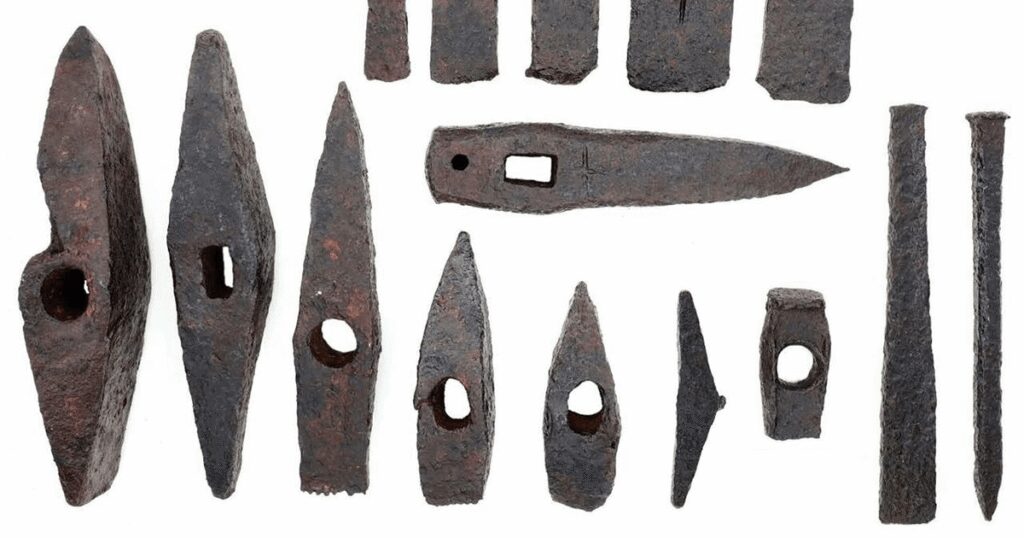
In summer 2022, a local resident stumbled upon a rusty set of iron tools buried at the base of a tree near the Măgura Călanului limestone quarry in Hunedoara County. This set, comprising 15 pieces, has been deemed one of the most comprehensive and varied stone-carving toolkits unearthed in ancient Europe. After its discovery, the toolkit was transferred to the Corvin Castle Museum.
Described in an article by archaeologist Aurora Pețan in Praehistorische Zeitschrift, the toolkit, dating back to the pre-Roman Iron Age, weighs around 11 kilograms. It includes five dual-headed chisels, two of which feature distinctly rare serrated edges, five splitting wedges of various sizes, a sharpening hammer, a portable field anvil, a flat chisel, a sharp finishing tool, and a small pick. This toolkit offers unique insights into the techniques employed by Dacian craftsmen, especially regarding quarrying and construction activities.
Pețan highlighted the rarity of the discovery, noting that some tools exhibit local innovations, indicating technological exchanges with the Mediterranean world alongside the ingenuity and adaptability of Dacian artisans. Notably, each tool in the set is unique, suggesting they likely belonged to a single highly skilled craftsman, possibly a master builder leading a group of workers.
The presence of certain tools, especially the toothed chisels, supports the theory that these items were distinctly Dacian and lacked equivalents in Greek or Roman toolkits. These tools were probably used to finish the prismatic limestone blocks characteristic of “ashlar” masonry found in Dacian fortifications. Smaller wedges, weighing between 150 and 400 grams, were apparently designed for splitting the soft limestone from the quarry, requiring less force.
The use of the sharpening hammer and the portable anvil is particularly significant, as these instruments were typically employed in the maintenance of agricultural tools like sickles. Their appearance in a quarry setting is rare, indicating that the stonecutter used them to keep his tools sharp while working with rapidly dulling stone.
Researchers speculate that the toolkit was intentionally hidden during the Roman invasion around 102 AD, never to be recovered by its owner. The quarry itself spans over 30 hectares with walls up to 8 meters high, and it shows numerous signs of extraction activities, including chisel marks, unfinished blocks, and abandoned debris. These remnants suggest the area may have been abruptly abandoned during a crisis.
A study indicates that the discovery at Măgura Călanului enhances our understanding of stoneworking craftsmanship in Dacia, challenging prior assumptions regarding construction and extraction techniques in the region. Modern analytical techniques, such as metallographic analysis and wear pattern studies, may reveal further details about how these tools were created and utilized.
The limestone extracted from Măgura Călanului was likely transported across rugged terrain for use in constructing large Dacian fortresses, such as Sarmizegetusa Regia, now a UNESCO World Heritage site. The rediscovery of this toolkit provides a direct and tangible link to the artisans who crafted those architectural masterpieces.


