
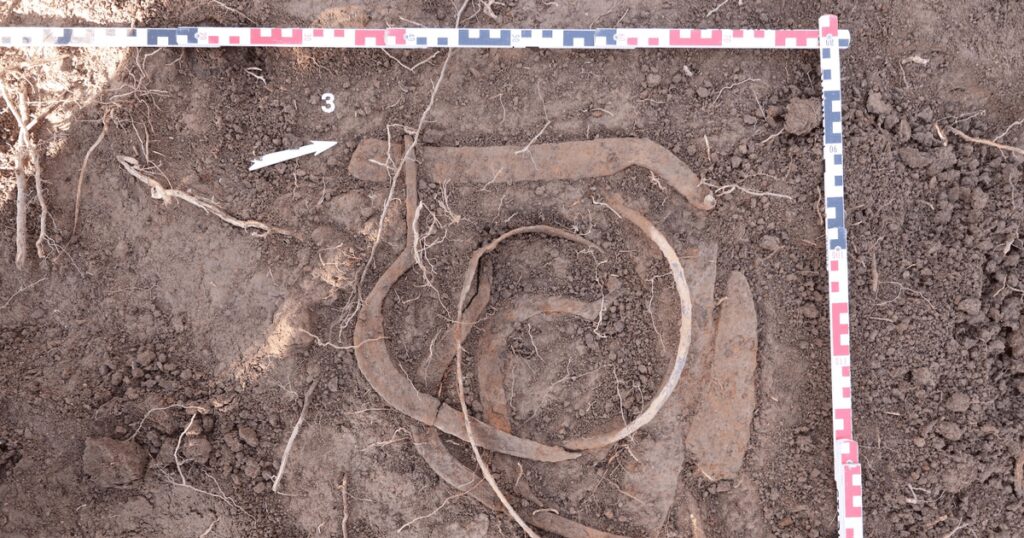
Recent archaeological research conducted by the Museum of History and Archaeology of Prahova County in the area of Plopu has unveiled significant finds from the early medieval period, specifically in the time frame of the 8th to 10th centuries AD. This research was initiated following a report by Professor Virgil Nitu from School No. 1 in Mizil, who alerted both the County Directorate for Culture Prahova and the Museum regarding the discovery of iron weapons and agricultural tools.
The archaeological diagnosis was conducted at a site known as Podul Rotarilor, situated in the Rotarilor Valley within Plopu commune. This evaluation led to the identification and recovery of over 80 items classified as weapons and agricultural tools, organized into four distinct deposits. Notably, the most striking artifacts included various military equipment such as battle axes, a spearhead, and a sword, alongside numerous agricultural and artisanal tools, including sickles, knives, plowshares, buckles, clamps, and rings. Additional remarkable items from these deposits comprised an anvil, a saddle stirrup, and a bridle.
During the course of these excavations, researchers also encountered numerous ceramic fragments among the soil covering the four deposits, indicating a potential early medieval settlement in the area that had previously gone undetected.
These recently found deposits complement an earlier one identified decades ago in an unspecified location within Plopu commune. Among the notable items from this earlier deposit were a bronze cauldron of the Pecheneg type and 11 Byzantine bronze coins.
The discoveries at Plopu hold substantial importance for understanding early medieval history in the Romanian landscape. They highlight the connections that existed between this region and the rest of Europe during a tumultuous period, often characterized by sparse historical records. Perhaps most significantly, they attest to the fact that the Subcarpathian Hills area of northern Muntenia was of considerable interest during the 8th to 10th centuries, a reality underscored by the archaeological findings.
The archaeological team involved in the Plopu research consisted of Dr. Bogdan Ciupercă (scientific supervisor), Dr. Cătălin Dîscă, and Eduard Ghinea. The fieldwork also included voluntary contributions from Virgil Nitu, who reported the initial discovery, along with Aurelian Iorga and Paul Padiu from the Museum of History and Archaeology of Prahova. These collective efforts contribute not only to local heritage preservation but also to a broader understanding of the historical dynamics of early medieval Romania.


