
Summary of AT2024tvd Event and Black Hole Discoveries
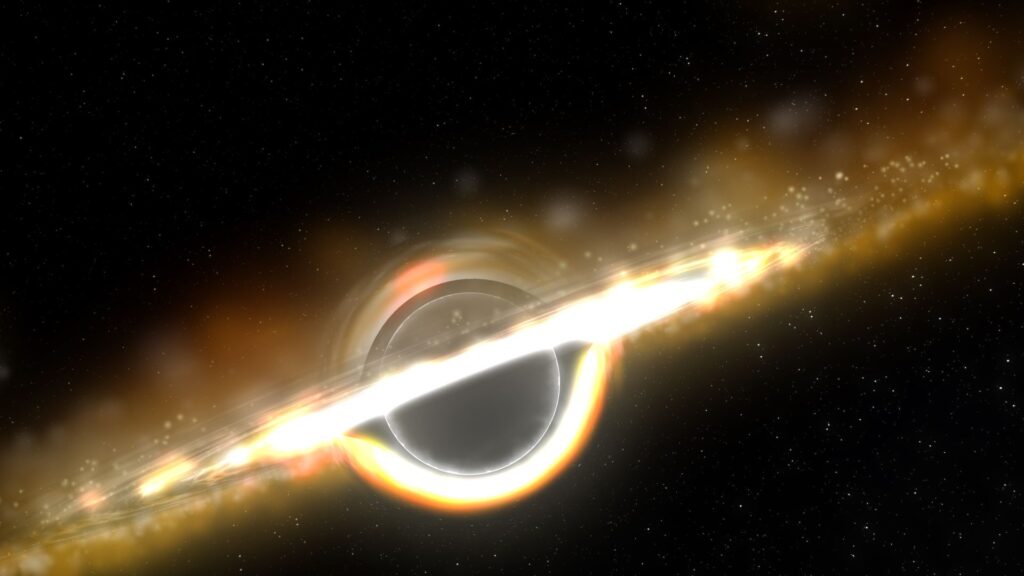
The event AT2024tvd represents the first optically detected "displaced" tidal disruption event (TDE) and highlights a powerful astronomical phenomenon. This occurrence involves a rogue black hole tearing apart a star before consuming it in a massive burst of radiation.
Discovery and Significance
A paper published in the Astrophysical Journal Letters by researchers at the University of California, Berkeley, explains this rare type of TDE that allowed for the identification of a massive, mobile black hole. Located approximately 600 million light-years from the Milky Way, this black hole became prominent due to the intense radiation resulting from the star’s "spaghettification"—a process where extreme gravitational forces stretch and compress the star.
Yuhan Yao, the lead author, noted that while massive black holes are commonly found at the centers of galaxies, this particular one is situated about 2,600 light-years away from the galactic center. This makes it the first optically discovered TDE of its kind.
The galaxy hosting this displaced black hole contains another one as well, raising questions about a potential future merger. Although improbable in the near term, such a merger could occur over billions of years, producing gravitational waves detectable across the universe. Yao suggests that this discovery will encourage more research into displaced TDEs.
Observational Tools
Initially detected by the Zwicky Transient Facility, the event allowed astronomers to pinpoint the black hole using both the Hubble Space Telescope and NASA’s Chandra X-ray Observatory. This “divine devourer,” as referred to in the article, revealed its cosmic prowess during the TDE, offering a method for astronomers to locate sporadic black holes throughout galaxies.
The presence of multiple black holes in a galaxy is not unusual; galactic collisions and mergers constantly evolve the cosmic landscape. Black holes can encounter stars roughly once every 30,000 years before devouring them, becoming visible in the process. After such events, they often remain undetectable until their next encounter.
Theoretical Predictions and Future Endeavors
Co-author Ryan Chornock emphasized that the existence of roaming black holes has long been theorized. The AT2024tvd event underscores the potential for astronomers to identify such elusive black holes by searching for TDEs. Future telescopic adjustments will enable a broader identification effort, furthering our understanding of cosmic phenomena.
The upcoming space mission "LISA" aims to detect gravitational waves from merging massive black holes, highlighting the broader implications of these discoveries in the field of astrophysics. Raffaella Margutti, another co-author, remarked on the unprecedented proximity of the discovered black holes and their visibility through TDEs.
In conclusion, UC Berkeley’s findings indicate that although the newly identified black hole is relatively close to the one at the center of its galaxy, any merger event is still billions of years away. This exciting development not only advances our understanding of black holes but also sets the stage for future astronomical research.
Recommended Readings
In addition, further exploration into other significant astrophysical discoveries reveals the ongoing excitement in the field:
- A colossal supermassive black hole has unveiled itself from a distant region of space.
- A black hole in the Virgo constellation has unexpectedly reactivated after years of inactivity.
- A black hole estimated to be 36 billion solar masses may lie at the heart of the Cosmic Horseshoe.
- Observations show a black hole appearing to “pull” stars toward us from the Large Magellanic Cloud.
The AT2024tvd event and similar discoveries continue to deepen our understanding of black holes and their roles in the universe, paving the way for new inquiries into these mysterious celestial objects.


