
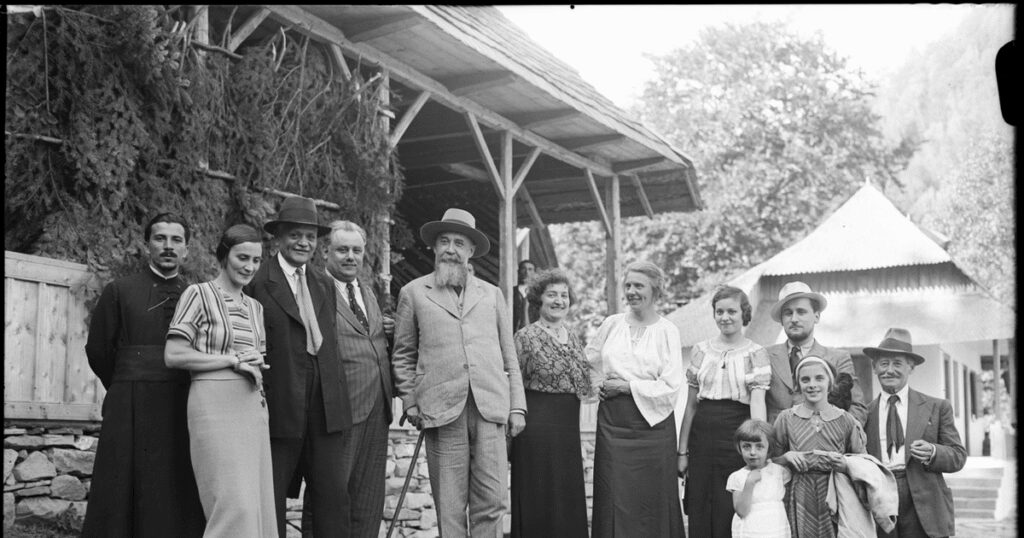
The exhibition “Port de sărbătoare din Țara Bârsei,” currently open at the Brașov Ethnographic Museum, showcases a valuable photographic collection from the archive of the Evangelical Church C.A. in Romania, specifically the Brașov parish. This collection is attributed to the significant ethnographer Luise Treiber-Netoliczka.
### Background on Luise Treiber-Netoliczka
Born in 1893 in Brașov to an intellectual family, Luise was the daughter of Dr. Oskar Netoliczka, the rector of the Evangelical High School in the city. Her brother, Oskar Gerhard Netoliczka, was a well-known photographer. Luise pursued her studies in German studies at universities in Budapest and Leipzig, eventually earning her doctorate from the University of Marburg in 1924.
Upon returning to Romania, she worked for nine years at the Ethnographic Museum of Transylvania in Cluj, under the direction of Professor Romulus Vuia. During her tenure, she played a crucial role in establishing scientific methodologies for museum curation, developed robust skills in the conservation of museum objects, and conducted extensive field research in areas such as Bistrița, Cluj, the Apuseni Mountains, and Brașov.
### Contribution to Ethnography
Throughout her research, Luise used photography to document traditional costumes and practices, with her works now housed in various institutions in Romania and Germany, including the Ethnographic Museum of Transylvania in Cluj and the Evangelical Church in Brașov.
In 1936, Luise returned to Brașov and shifted her focus to teaching at the Evangelical Girls’ School while maintaining her interest in ethnography. She actively engaged with various organizations and museums, such as the Romanian Women’s Union in Brașov and the Saxon Museum of the Bârsa Country, fostering cultural and scientific exchange.
Despite experiencing exclusion from cultural life during the early years of communist rule due to ideological reasons, she was re-integrated into academic research in the 1950s, collaborating with ethnographer Nicolae Dunăre on several projects.
### Later Life
In 1963, Luise immigrated to Germany with her husband, Gustav Treiber, an engineer and historian. Although they were both advanced in age—Luise being over 70 and Gustav over 83—they devoted their final years to documenting their extensive research in Romania.
### The Exhibition
The “Port de sărbătoare din Țara Bârsei” exhibition invites visitors to engage with the visual world of traditional attire from the Bârsa region, providing a unique opportunity to rediscover through Luise Treiber-Netoliczka’s lens a genuine world of remarkable beauty and depth.


