
The content discusses the economic turmoil and military developments during the late 1920s and 1930s, particularly focusing on the aftermath of the New York stock market crash, which triggered a global recession and conflicts leading up to World War II.
### Economic Context
The Great Depression led to a significant downturn in global economic activity. Industrial production plummeted, particularly in heavy industries, as orders diminished dramatically. Construction activities came to a standstill, and numerous banks failed under financial strain. However, this portrayal of widespread industrial stagnation did not capture the complete reality, especially in Eastern Europe, where military demands created a paradoxical scenario.
### Military Demands and Industrial Activity
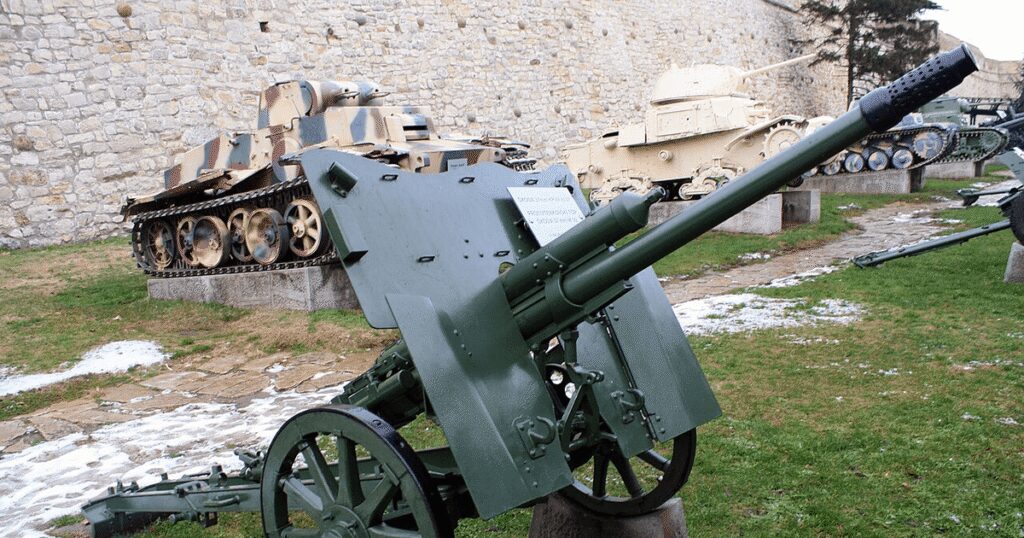
Despite the economic difficulties, countries like Romania were engaged in an arms buildup due to escalating tensions in Europe. Romania ordered artillery, specifically 248 pieces of 100 mm caliber howitzers from Czechoslovakia, to enhance its infantry divisions. These howitzers were essential for neutralizing enemy artillery and were effective even against troops in trenches.
Each howitzer weighed 1,560 kg and required specialized auto-tractors for maximal operational efficiency on the modern battlefield. Romania also requested 180 units of 150 mm caliber artillery from Škoda, indicating an investment in more powerful weaponry that demanded heavier equipment.
### International Partnerships and Delays
Czechoslovakia was a key partner in supplying military equipment, but Romania also sought arms from countries like France. For example, 47 mm anti-tank guns from Schneider were ordered, though delays in production hampered timely deliveries. Despite the challenges, local production initiatives sprang up, particularly in Ploiești, where effective anti-tank artillery was developed.
### Military Innovation and Production
The Romanian military industrial complex made considerable advancements during this period. A notable success was the development of a light artillery piece capable of combatting Soviet tanks weighing 628 kg. The shift towards local manufacturing illustrated a growing self-reliance in military capabilities during a time characterized by economic despair.
During the interwar years, large powers across Europe demanded massive quantities of military technology, and countries like Poland became significant players in this market. Their interest in anti-tank guns, particularly the 37 mm Bofors model, showcased the transformative capabilities of contemporary designs, often resulting in substantial production numbers.
### Misconceptions About Economic Reality
Despite historical analyses claiming that the military-industrial sector was faltering, cities like Brno and Pilsen in Czechoslovakia were overwhelmed with armament orders, showcasing a robust industrial activity contrary to prevailing narratives of stagnation. This period metaphorically illustrates how the demands of impending conflict can paradoxically invigorate specific sectors of an economy, countering the broader trends of recession.
In conclusion, while the Great Depression inflicted heavy wounds on many economies, particularly in the West, nations in Eastern Europe, like Romania, leveraged the military demands to stimulate industrial growth and rearmament in anticipation of future conflicts. The narrative of economic despair often oversimplifies the complexity of industrial responses in the face of geopolitical tensions.


