
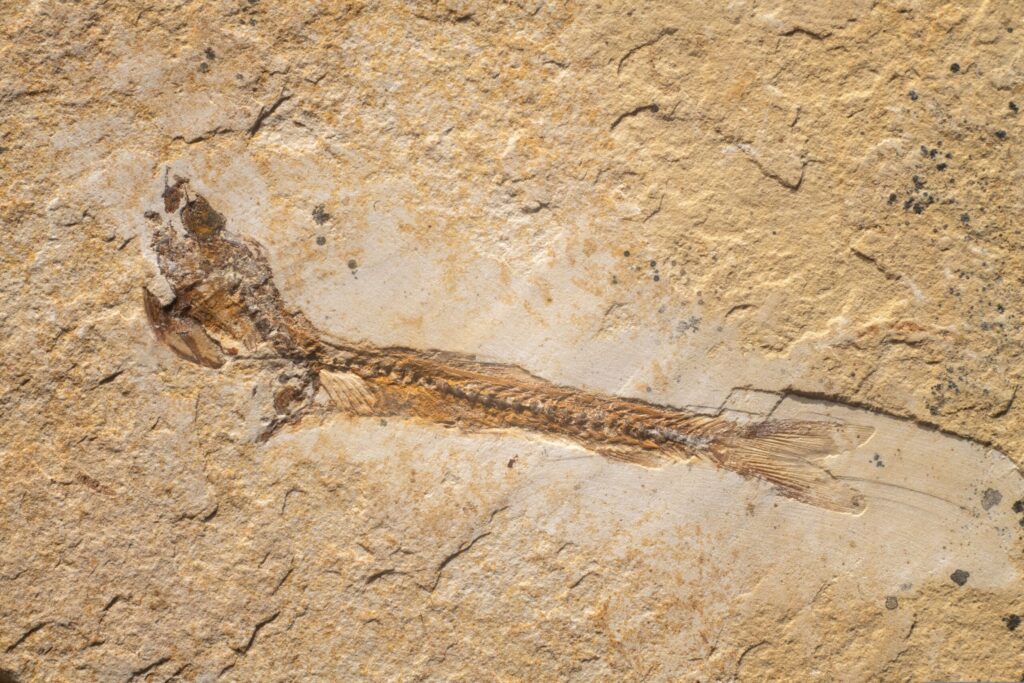
Researchers at Virginia Tech have unearthed a 225-million-year-old fish fossil known as Saurichthys justicias. This ancient species showcases a long, tooth-filled jaw reminiscent of modern pike and barracuda, despite having evolved independently and from a completely different evolutionary lineage millions of years earlier.
The fossil belongs to an extinct group of fish characterized by their ray-finned structures. Saurichthys justicias, a Triassic predator, developed sharp elongated jaws similar to contemporary species that exhibit ambush hunting strategies. Jack Stack, the lead author of the study, notes that similar evolutionary problems are solved in similar ways across species: essentially, evolving a streamlined form and transforming jaws into fish-catching traps.
The discovery of the fossil took place in a sedimentary deposit in West Texas, which was once a muddy riverbed near what is now Justiceburg, an area recognized for preserving fossilized fish remains. The environment was described by Stack as a "muddy pool filled with dead animals, dead fish."
The identification process involved washing sediments and carefully examining them under a microscope. Following the identification of the jawbone, researcher Stricklin conducted a detailed analysis using micro-CT scanning to visualize the internal 3D structure of the fossil. The 3D model indicated that Saurichthys justicias was a hydrodynamic predator approximately 30 cm long, with narrow jaws and sharp teeth, similar to modern ambush predators like pike. However, it belongs to a distinct evolutionary line within ray-finned fishes.
Ray-finned fishes today account for over half of the vertebrate species on Earth, including popular varieties like goldfish, tuna, and bass. The study of such fossils provides crucial insights into the adaptations of ancient members of this diverse group and sheds light on why certain traits, such as torpedo-shaped bodies and tooth-filled jaws, have repeatedly evolved throughout history.
Understanding the history of these fish presents vital perspectives on Triassic ecosystems and offers answers to persistent questions about evolution and environmental changes. Researchers aim to leverage insights gained from past fish adaptations to better predict how contemporary aquatic life may respond to climate change and shifting ecosystems.
The findings have been formally published in the Journal of Vertebrate Paleontology, contributing to the broader knowledge of evolutionary biology and the history of Earth’s ecosystems. Upcoming articles are also poised to further explore interesting fossil discoveries, including a rare 2.6-million-year-old fossil from Japan and a well-preserved 30,000-year-old eagle fossil found in Italy.


