
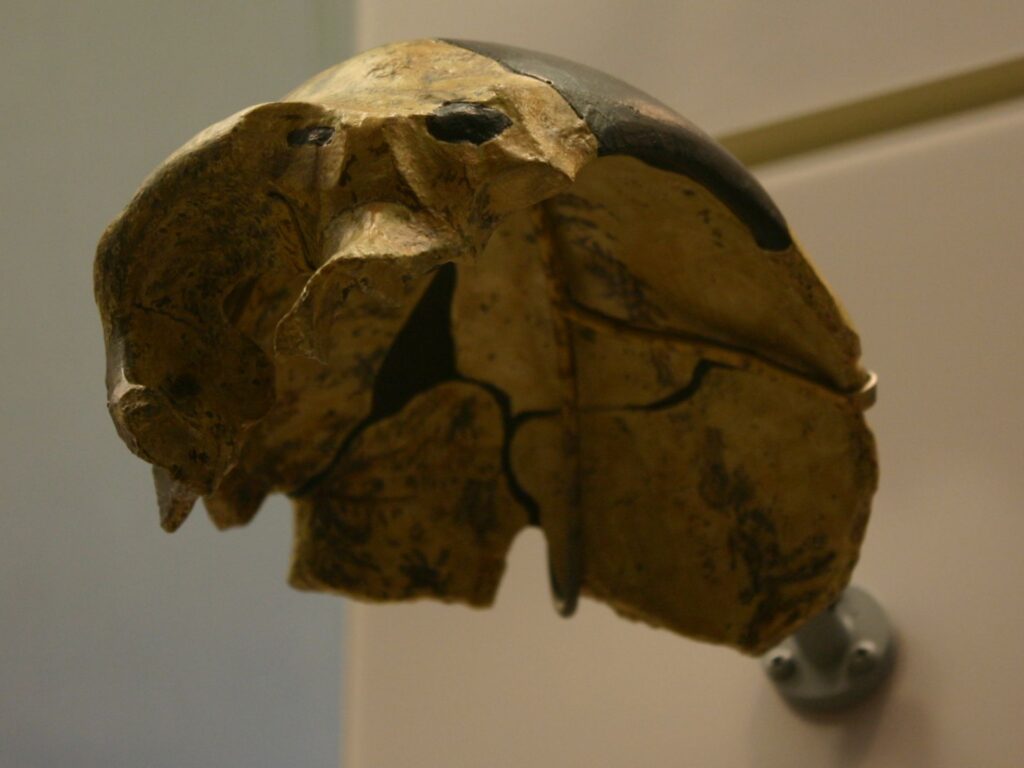
The story of human evolution is far more intricate and chaotic than most people realize, enriched with figures that challenge our understanding of our ancestors. One such prehistoric enigma is Maba 1, a skull approximately 300,000 years old discovered in 1958 by farmers collecting bat guano in Guangdong, China. This skull fragment and some facial bones do not align with any known human species.
Initially dubbed the "Chinese Neanderthal" due to facial similarities, Maba 1 was later subjected to a detailed analysis of its internal structures, such as sinuses and the brain cavity, through CT scans. Findings reveal a mix of traits from various archaic hominins, complicating any classification attempts.
For instance, while the skull’s overall shape is closer to that of Homo erectus, the frontal lobe is too short for it to be classified as a true H. erectus. Despite previous studies suggesting a potential relation to Denisovans, the CT scans indicated a smaller brain volume than that of Denisovans. Consequently, researchers concluded that Maba 1 does not fit into any recognized hominin group.
Such discoveries, though seemingly rare, are not uncommon for this period, often referred to by anthropologists as the "great confusion of the middle." The Middle Pleistocene was a time of exceptions and transitions, wherein the distinctions between human species were far less clear than today. Other similar unclassifiable hominins have surfaced in Africa and Eurasia, suggesting a complex tapestry of human evolution characterized by fluidity and overlap among prehistoric populations.
In fact, Maba 1 shares more similarities with certain African specimens, such as semi-sapiens from Morocco and Tanzania, rather than Neanderthals, despite existing in great geographical divergence. These findings reinforce the notion that human evolution during the Middle Pleistocene was chaotic, lacking clear boundaries among different species.
The authors of the study, published in the American Journal of Biological Anthropology, thus propose that the most fitting label for Maba 1 would be "non-erectus," highlighting our ongoing struggle to understand human ancestry.


