
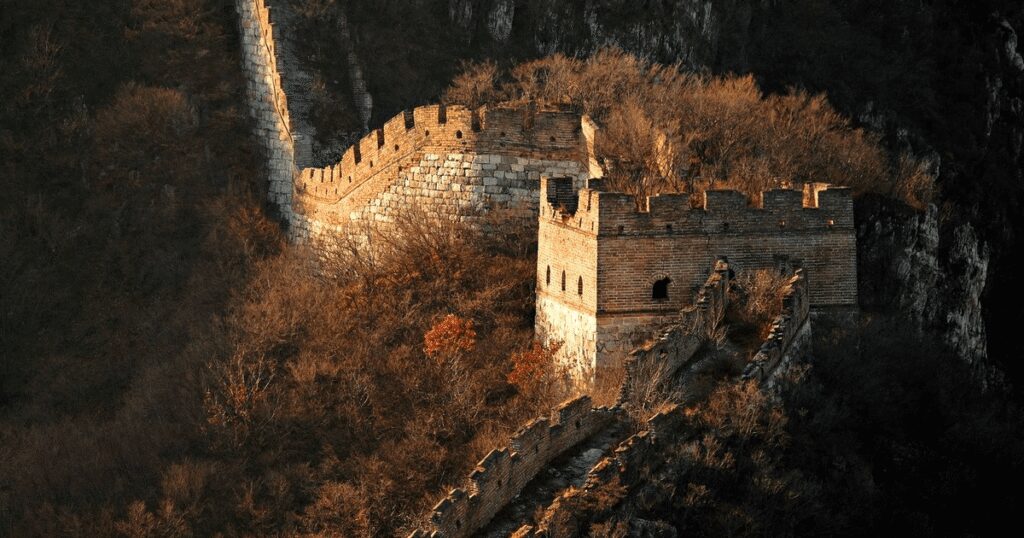
Recently, nine sections of what is believed to be part of the Great Wall of China have been discovered in Gansu province, northwestern China. These sections were found in Jingyuan County, Baiyin City, and are thought to date back over 2,000 years.
Archaeologists have concluded, based on features like the thickness of compacted earth layers, that these walls were initially constructed during the Qin Dynasty (221-207 BC). One notable section is the Yingu Great Wall, which displays a variance in the loess soil colors on its eastern and western sides, indicating that different construction periods were involved, as reported by Du Baoze from the Cultural Relics Protection Bureau in Jingyuan.
The remaining eastern section resembles a mound, standing at 5.2 meters tall, 4.5 meters wide, and 11 meters long. Its characteristics have led researchers to compare it with lookout towers built during the Ming Dynasty (1368-1644), suggesting it displays features representative of the Qin Great Wall, while the western part appears to have been restored during the Ming era.
The Yushugou, Longhuangshui, and Huangtianqi sections demonstrate a similar stone structure, hinting they were constructed simultaneously. Most of these stone walls were built in strategically significant locations, often nestled between canyons or atop terrain that provided natural defensive advantages. This aligns with a hallmark of the Qin Great Wall’s design, which followed local topography to maximize natural defense while minimizing construction efforts.
The Great Wall of China, a UNESCO World Heritage Site, consists of various interconnected walls, some dating back over 2,000 years. The oldest segments were commissioned by the first emperor of the Qin Dynasty, who initiated the construction to protect against tribes located north of China’s borders.
These discoveries underscore the historical significance and engineering prowess of ancient China and contribute to our understanding of the Great Wall’s extensive history and development.


