
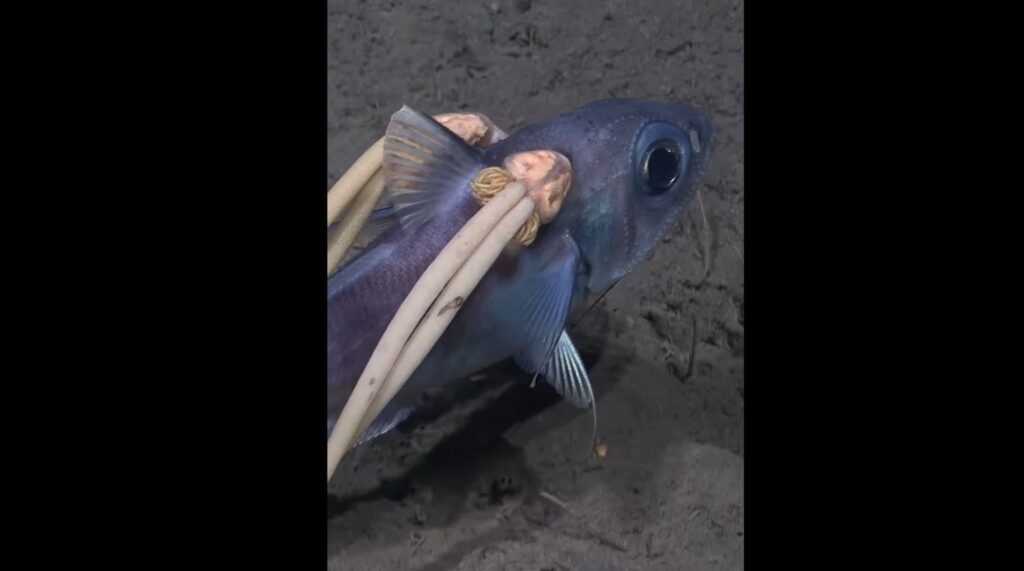
A recent video released by the Schmidt Ocean Institute showcases a shocking sight: two copepods, small parasitic crustaceans, are seen feeding on the blood of a deep-sea fish from the Macrourus family. This eerie scene was filmed at a depth of 489 meters during a research expedition focused on the ocean floor and biodiversity near the South Sandwich Islands.
The particular species caught on camera is Lophoura szidati. Each copepod is attached to either side of the fish’s head, giving the fish the appearance of having two tails due to the long egg sacs trailing from the parasites. These copepods employ specialized mouthparts to penetrate the fish’s muscles, consuming its blood and fluids.
James Bernot, an evolutionary biologist at the Smithsonian National Museum of Natural History, explained the significance of this discovery. He noted that while not much is known about deep-sea parasites in Antarctic waters, Lophoura szidati is one of the most commonly found parasites associated with Macrourus species in that region.
Copepods, part of the Sphyriidae family, exhibit a unique parasitic behavior. The females have specialized structures that allow them to pierce the host’s body, feeding directly on its muscular tissues. These copepods are classified as mesoparasites: parts of their bodies remain within the host while others extend outward.
Copepods undergo multiple developmental stages. Tiny larvae penetrate the host’s skin and begin to feed. As they grow, they metamorphose and develop attachment structures. The video illustrates these parasites carrying two sacs filled with hundreds of eggs, highlighting their reproductive strategy.
Interestingly, copepods display surprisingly nurturing behavior for invertebrates. They carry their eggs in sacs attached to their bodies until the eggs hatch into free-swimming larvae, which then seek out their own hosts. Although little is known about the life cycle and longevity of these parasites, Bernot suggests they remain attached to their hosts for extended periods, possibly months, as they transition from microscopic larvae to fully formed adults.
Even after death, the remnants of the copepod’s head can persist in the host fish’s tissues for years, indicating a prolonged relationship between host and parasite. This fascinating dynamic offers important insights into the ecological roles of parasites in deep-sea environments, where the understanding of such relationships remains limited.


